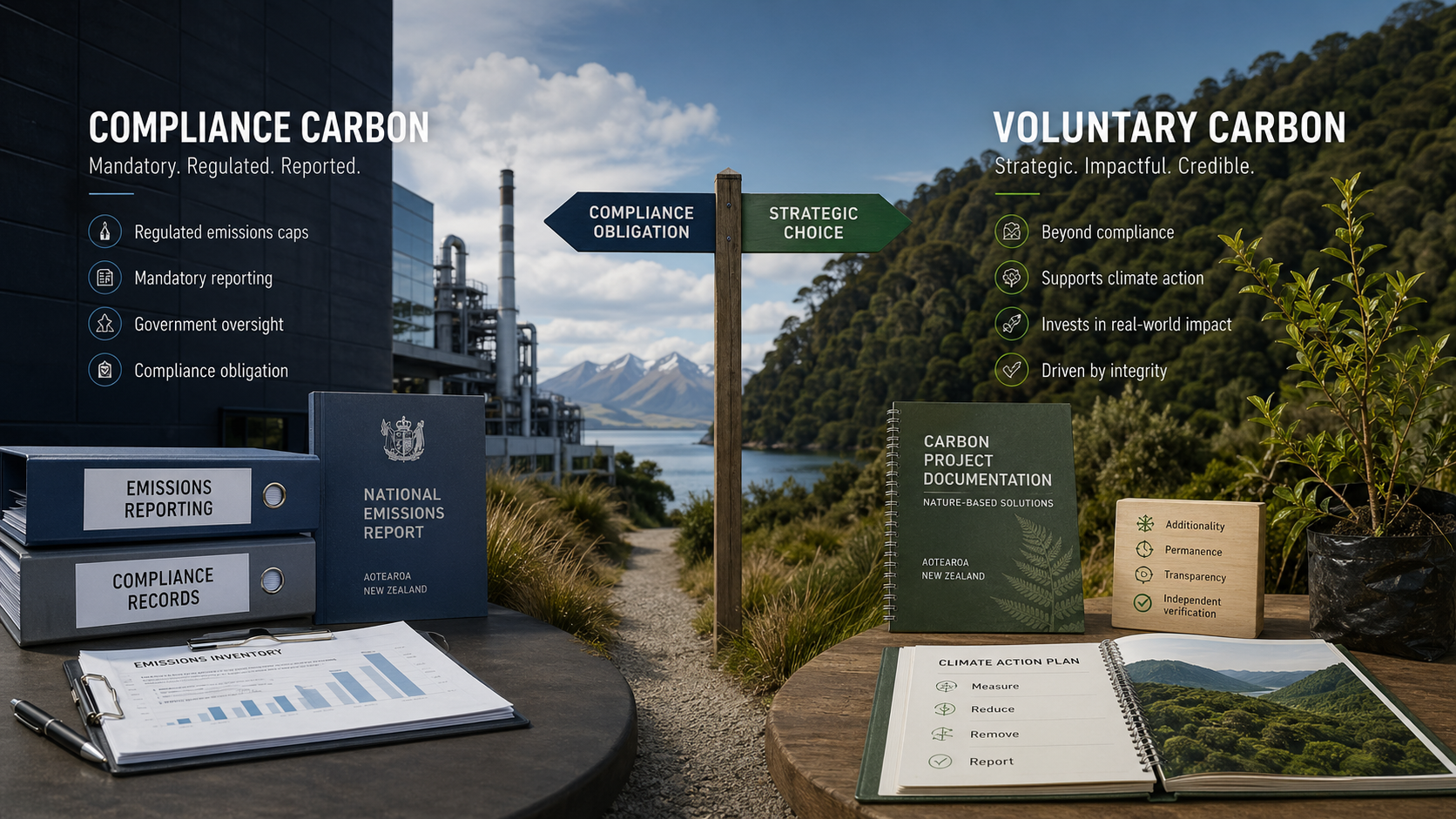
A guide to how New Zealand businesses should approach carbon procurement, from defining purpose and separating compliance from voluntary action to setting quality thresholds and claims policy.
Carbon procurement is the process of buying carbon credits or related carbon instruments to address residual emissions or support a defined climate strategy.
For New Zealand businesses, the key is to treat procurement as a policy and credibility decision, not just a buying exercise.
For a lot of businesses, carbon procurement starts in the wrong place.
Someone asks what credits cost, a few brokers send through options, and the discussion quickly turns into a buying exercise.
That is understandable, but it is not a strong foundation.
A better approach is to treat carbon procurement as a policy decision before it becomes a purchase decision.
For New Zealand businesses especially, that matters because carbon sits at the intersection of cost, credibility, regulation, and reputation.
Carbon procurement is the process of selecting and buying carbon credits in a way that fits a business’s actual climate objective, claims policy, and risk tolerance.
In practice, that means deciding why the business is buying, what quality thresholds matter, what claims may follow, and how purchased carbon fits alongside direct emissions reductions.
Before buying anything, a business should answer a simple question:
Why are we procuring carbon at all?
Possible answers include:
Those are not identical objectives. The right credit type, standard, geography, and messaging may differ depending on which objective matters most.
One of the biggest sources of confusion is mixing together compliance obligations and voluntary climate action.
A business should be clear about:
That distinction helps prevent weak procurement decisions and even weaker communications.
Carbon procurement works best when it sits behind a clear internal hierarchy.
That hierarchy usually looks something like this:
Without that structure, carbon purchasing can look like a substitute for operational change.
This is where procurement quality becomes more important than price alone.
A serious buyer should ask:
The compliance and voluntary markets have matured to the point where “a tonne is a tonne” is no longer a safe assumption.
New Zealand businesses often have a stronger story to tell when carbon procurement connects to local context.
That could mean preferring projects that offer:
For some businesses, native forest carbon may be especially relevant here. Not because every native forest credit is automatically better, but because local ecological value, biodiversity outcomes, and social licence can matter just as much as the headline carbon number.
This is the part many organisations leave too late.
If the communications team does not know what can honestly be said, procurement risk goes up.
A business should define in advance:
That discipline matters more now than it used to. Buyers are under more scrutiny, and vague “carbon neutral” style messaging often attracts the wrong kind of attention if the underlying strategy is weak.
A good supplier will provide guidance around the claims you can make with the credits they are selling you.
A useful executive / board-level test is this:
What is the procurement for?
What quality thresholds must every credit meet?
Do we care where the project is and what else it delivers?
Are we solving for a one-year claim, or building a multi-year strategy?
How will we describe the role of purchased carbon honestly?
If a business can answer those questions, it is already ahead of most ad hoc buyers.
Carbon procurement should not be driven by whatever is cheapest or most available that week.
It should be driven by strategy.
For New Zealand businesses, the strongest approach is usually one that combines direct emissions reduction, a clear residual-emissions policy, strict integrity standards, and a procurement lens that values local relevance and long-term credibility.
That is less convenient than buying the first tonne offered.
It is also far more likely to stand up when someone asks the obvious follow-up question:
Why did you buy this, and what exactly do you think it does?
Good carbon procurement is not about buying any tonne available. It is about buying the right carbon, for the right purpose, under a defensible strategy.