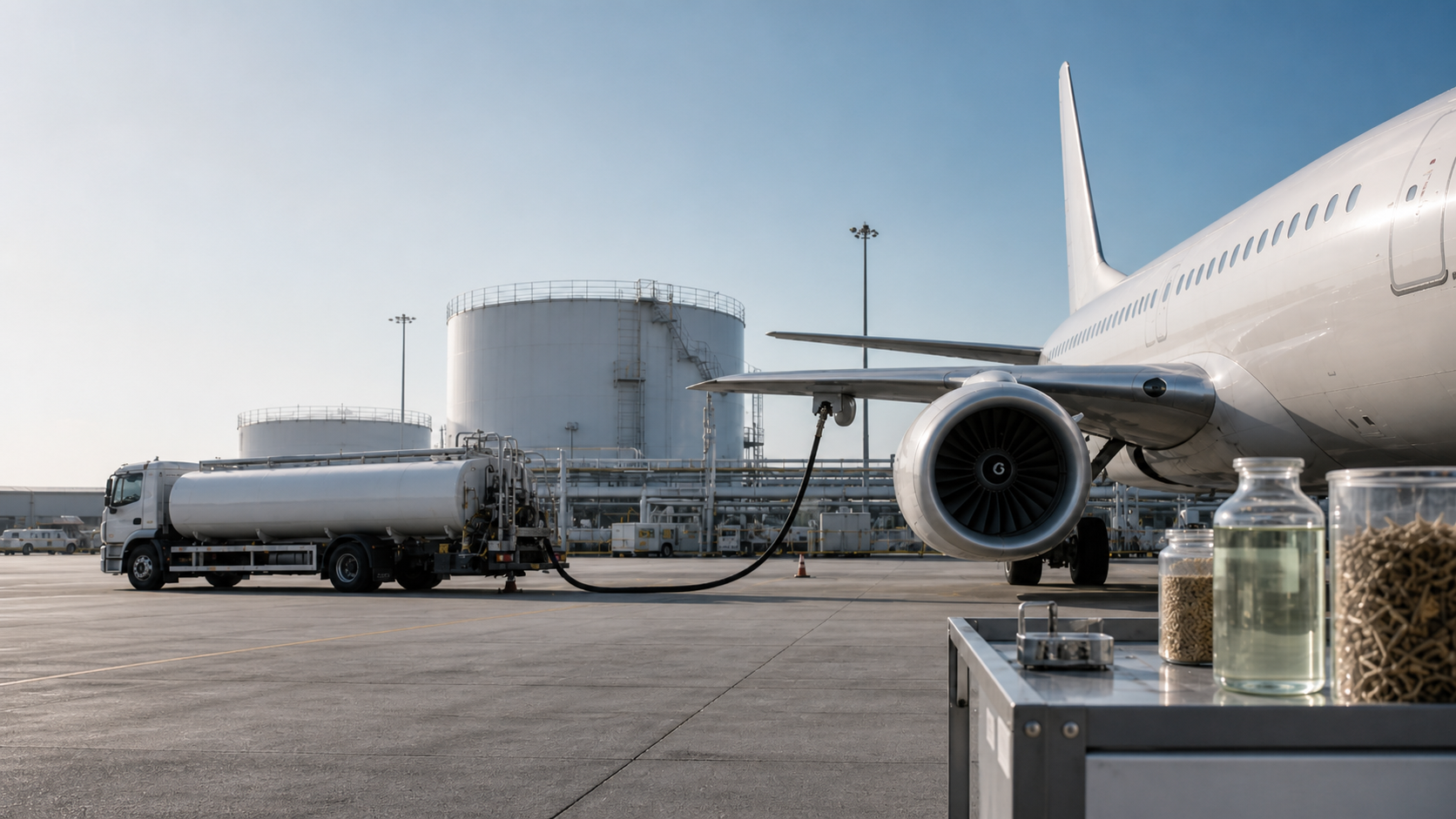
A concise explainer of sustainable aviation fuel (SAF), what it is, why it matters for aviation decarbonisation, and how businesses should think about it without overstating its role.
Sustainable aviation fuel (SAF) is a lower-emissions alternative to conventional jet fuel made from approved renewable or waste-derived feedstocks.
It matters because aviation is difficult to decarbonise, and SAF is one of the few near-term tools that can reduce emissions within the sector itself while working with existing aircraft and fuel infrastructure.
It is not a complete solution, but it is one of the most practical transition tools currently available.
In simple terms, SAF is produced from approved renewable or waste-derived feedstocks and used within existing aviation fuel systems as a drop-in blend, rather than requiring a complete redesign of the aircraft fleet.
Aviation is not like light road transport, where electrification already provides a clear direction of travel.
Aircraft need high energy density, global fuel compatibility, strict safety standards, and infrastructure that works across international networks. Those constraints make rapid decarbonisation difficult.
So while efficiency gains matter, and future technologies may play a larger role over time, there are limited near-term options that can make a meaningful dent in emissions at scale.
That is where SAF comes in.
SAF is designed to reduce lifecycle greenhouse gas emissions compared with conventional fossil jet fuel.
The exact reduction depends on the production pathway and feedstock, but the broad principle is that SAF can lower the emissions intensity of aviation fuel while still functioning within today’s aircraft and fuel infrastructure.
This is why industry and policy bodies treat it seriously.
IATA has described SAF as potentially delivering a large share of the emissions reductions aviation needs on the path to net zero. ICAO likewise identifies SAF as having major decarbonisation potential for international aviation.
This is probably the biggest point.
SAF is not a workaround outside the sector. It is a way of changing the fuel mix within aviation itself.
That makes it more strategically aligned with real sector transition than approaches that only compensate for emissions elsewhere.
SAF is valuable partly because it does not depend on waiting for an entirely future fleet. That makes it one of the more practical transition tools available today.
Aviation decarbonisation is full of long-term ambitions. SAF matters because it is one of the few areas where market participants can act now, even if the market is still immature.
It would be a mistake to talk about SAF as though it solves aviation emissions on its own.
SAF adoption is still constrained by limited supply, higher cost than fossil jet fuel, and the need for credible sustainability, policy, and accounting frameworks.
So SAF is important, but it is not simple.
For companies with meaningful aviation emissions, SAF is best understood as an in-sector reduction lever.
That means it belongs in a different category from carbon offsetting.
If a company wants to support aviation’s actual decarbonisation pathway, SAF is one of the clearest tools available. If it wants to deal with residual emissions more broadly, carbon credits may still play a separate role — but they should not be confused with fuel-system decarbonisation.
No.
SAF reduces emissions intensity within the aviation fuel system, while carbon offsetting compensates for emissions outside that fuel system.
Both may appear in a climate strategy, but they do different jobs and should not be treated as interchangeable.
New Zealand businesses are often exposed to aviation more than they would like, whether through long-haul travel, tourism, freight, or international market access.
That makes aviation emissions unusually relevant.
As SAF markets mature, businesses will increasingly need to understand what SAF is, what it can realistically do, what it does not solve, and how to talk about it without overstating climate impact.
SAF matters because aviation is difficult to decarbonise and the list of credible options is still short.
It is not perfect. It is not abundant. And it is not cheap.
But it is one of the few tools that can help lower aviation emissions from inside the sector itself.
That alone makes it worth understanding properly.