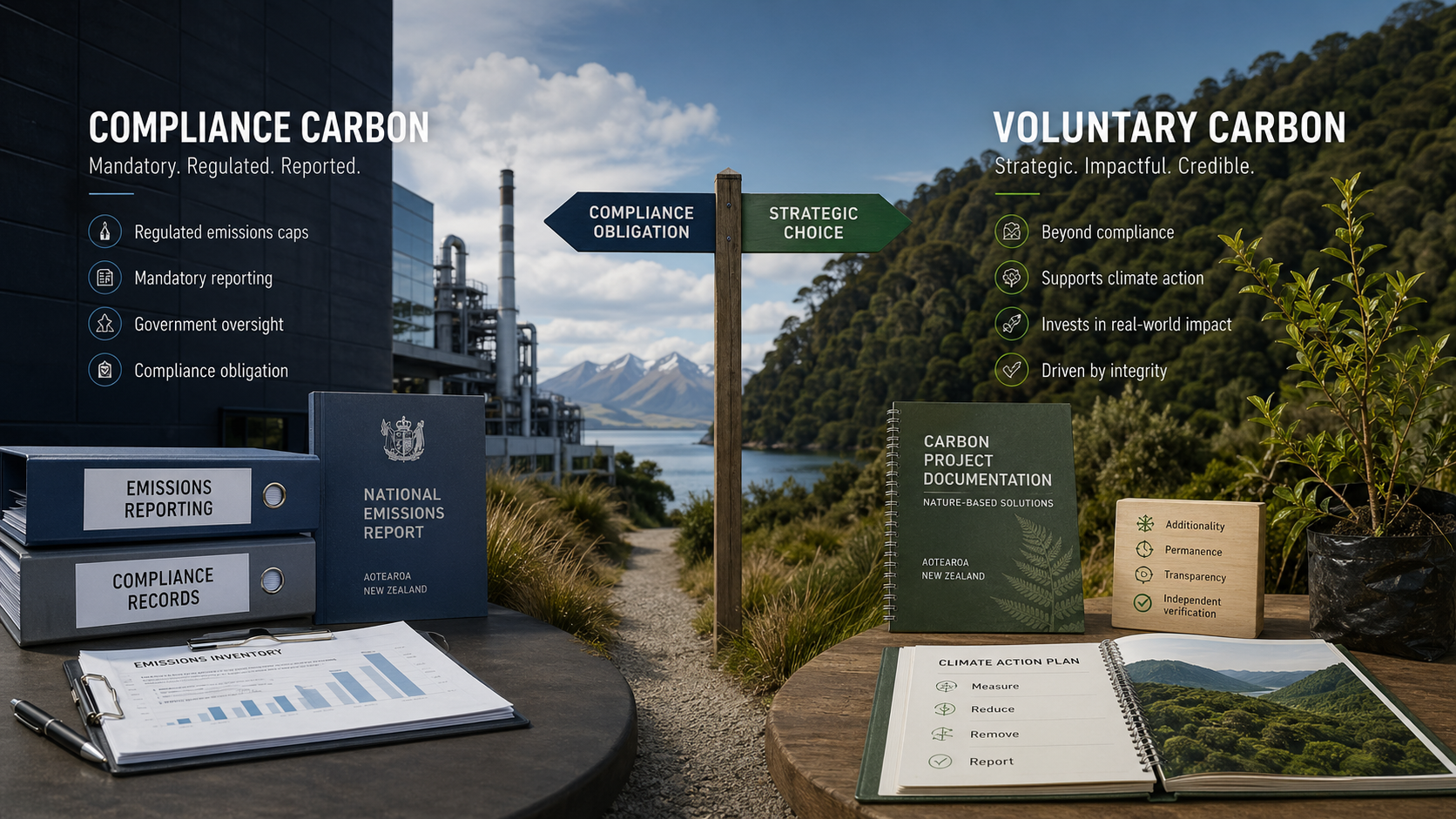
A practical guide to the difference between compliance carbon and voluntary carbon, including why the line can blur in cases like CORSIA and what that means for buyers.
People often use the word “carbon” as though it describes a single market.
It does not.
One of the most useful distinctions a buyer (or seller) can make is the difference between compliance carbon and voluntary carbon.
If you miss that distinction, decisions get messy.
Compliance carbon exists within a regulated system.
In simple terms, it is tied to a legal obligation. A business, sector, or participant is required to account for emissions under rules set by government or regulation.
The exact design varies by jurisdiction, but the core idea is consistent: the market exists because participants must comply.
That makes compliance carbon fundamentally a policy instrument.
For New Zealand readers, this category is easiest to understand as the carbon world that sits inside mandatory emissions policy settings of the Emissions Trading Scheme.
Voluntary carbon sits outside a direct legal obligation.
A business buys voluntarily because it wants to:
That means voluntary carbon is less about statutory compliance and more about strategy, reputation, and intent.
The simplest way to explain it is this:
That difference affects almost everything else - the buyer mindset, the procurement process, the standards used, and the claims that can be made.
They get confused because both involve carbon units, pricing, and market language.
But the buyer’s job is different in each case.
In a compliance setting, the main question is often whether the unit is eligible and how it fits the rules.
In a voluntary setting, the harder question is often whether the purchase is credible, high integrity, and fit for purpose.
That is why voluntary procurement can require more judgment than people expect.
The distinction is useful, but real markets do not always stay perfectly separate.
A good example is CORSIA, the international aviation carbon scheme created under ICAO. For airlines covered by CORSIA, the obligation is compliance-based: eligible operators may need to cancel approved emissions units to meet a mandatory international requirement.
But the units used for that compliance task do not come from a completely separate “compliance market” in the same way NZUs come from the NZ ETS. In practice, CORSIA has relied on approved crediting programmes that many people would normally associate with the voluntary carbon market, provided those programmes and units meet ICAO’s eligibility criteria.
That creates an important grey zone. The obligation is compliance, but some of the supply comes from crediting infrastructure that sits much closer to the voluntary market world.
This matters because it shows that “compliance” and “voluntary” can describe different things:
Aviation is the clearest example, but it is not the only place where boundaries can blur. In some sectors, companies may face quasi-mandatory expectations from customers, regulators, supply chains, or international frameworks that push them toward high-integrity credits even when they are not operating inside a domestic cap-and-trade scheme.
Because voluntary buyers are making a choice, they usually face more scrutiny around why they bought what they bought.
Questions come quickly:
That is where integrity frameworks become important. Bodies such as ICVCM have pushed the market toward clearer standards, clearer use cases, and more careful claims.
It would be a mistake to think compliance carbon is automatically good and voluntary carbon is automatically dubious.
The real issue is fit, integrity, and transparency.
A voluntary purchase can be highly strategic and well-governed.
A poorly thought-through voluntary purchase can be reputationally expensive.
Likewise, participating in a compliance market does not remove the need to think carefully about cost, timing, exposure, and wider business implications.
New Zealand businesses increasingly operate across both mindsets.
A company may have exposure to mandatory carbon settings in one part of its operations while also considering voluntary purchases for customer-facing commitments, residual emissions, or local environmental goals.
If those two motives are mixed together carelessly, internal confusion follows.
A better approach is to keep them separate:
The distinction matters because it changes the job the buyer is actually doing. In a compliance setting, the focus is usually on eligibility, legal rules, timing, and cost exposure. In a voluntary setting, the focus shifts toward quality, purpose, and claims discipline. And in blurred cases like CORSIA, it becomes even more important to ask both questions at once: what obligation is this purchase serving, and what kind of crediting system is actually supplying the unit? If a business cannot answer that clearly, the procurement conversation is probably not ready yet.